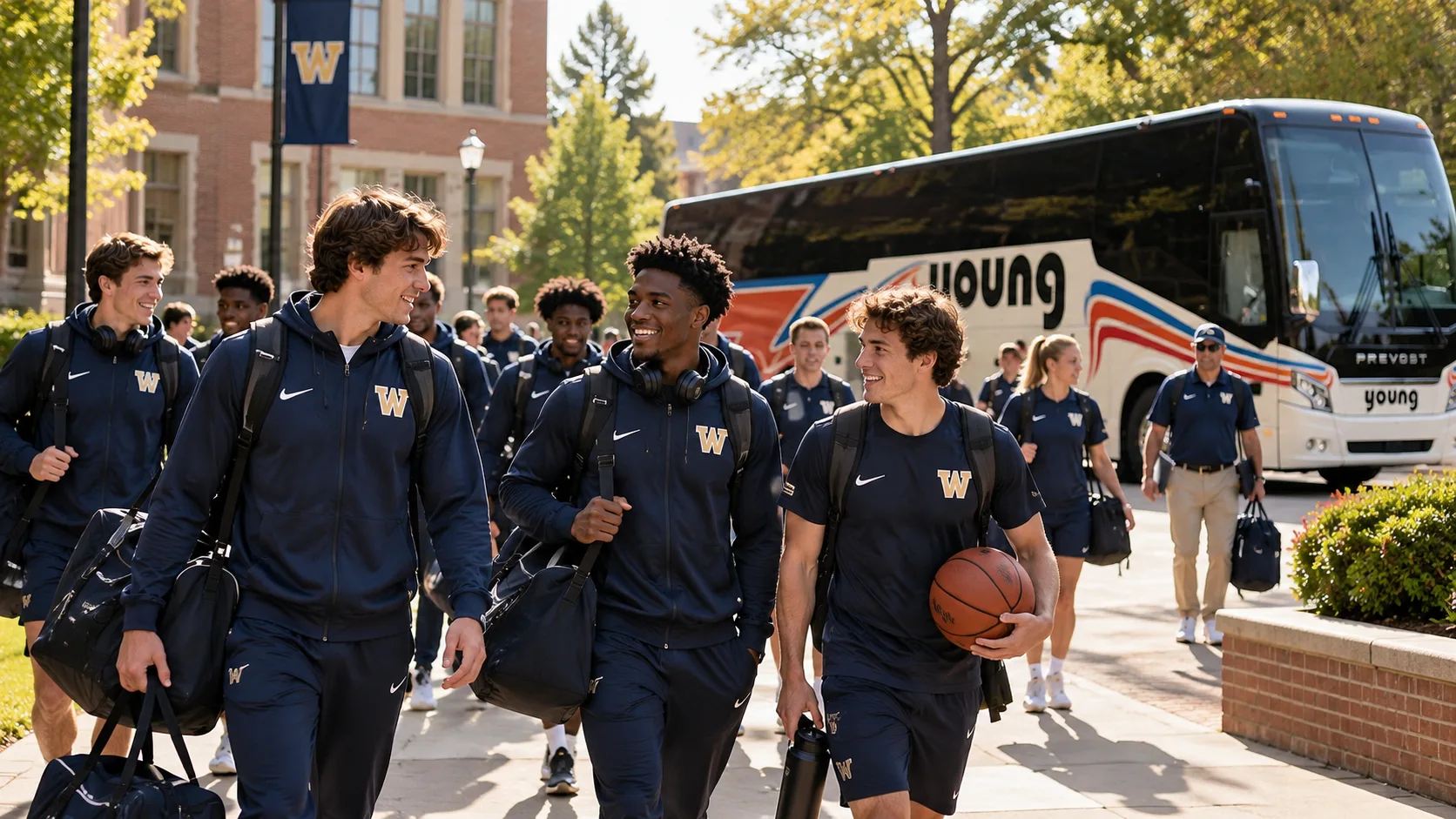

For college athletic teams, more time is spent on travel than playing.
Away games, tournaments, invitationals, championships, and training trips can mean dozens of hours on the road throughout the year. And when athletes, coaches and staff are traveling before or after competition, the experience onboard matters.
At a Glance — Charter Bus Amenities for College Athletic Teams
- Key amenities: Reclining seats · Undercarriage equipment storage · Wi-Fi and charging · Climate control · Onboard restroom · Entertainment options
- Best for: Away games · Tournaments · Invitationals · Championships · Training trips · Multi-day road trips
- Vehicle options: Minicoaches (Up to 36 passengers) · Full-size motorcoaches (40–56 passengers)
- Plan with: Young Transportation — Request a Quote · (800) 622-5444 · Response within one business day
Away games, tournaments, invitationals, championships, and training trips can mean dozens of hours on the road throughout the year. And when athletes, coaches and staff are traveling before or after competition, the experience onboard matters.
Research published through the NCAA and multiple sports science institutions consistently shows that travel takes a measurable toll on college athletes — affecting sleep quality, recovery, and in some cases, competitive outcomes. A study tracking Division I women’s basketball found that games played across time zones were significantly more likely to be lost over the course of five seasons. Separate research on Division I women’s soccer found that athletes averaged roughly 40 minutes less sleep on travel days, with later bedtimes on return nights compounding the deficit.
A charter bus needs to do more than get the team from campus to the venue. The right amenities can be an opportunity for players to arrive rested, coaches stay organized, and make long travel days easier for everyone onboard.
Here are the amenities worth considering when planning transportation for a college athletic team.
Comfortable Seating and Room to Stretch Out
After a game, meet, or tournament, athletes need a chance to recover.
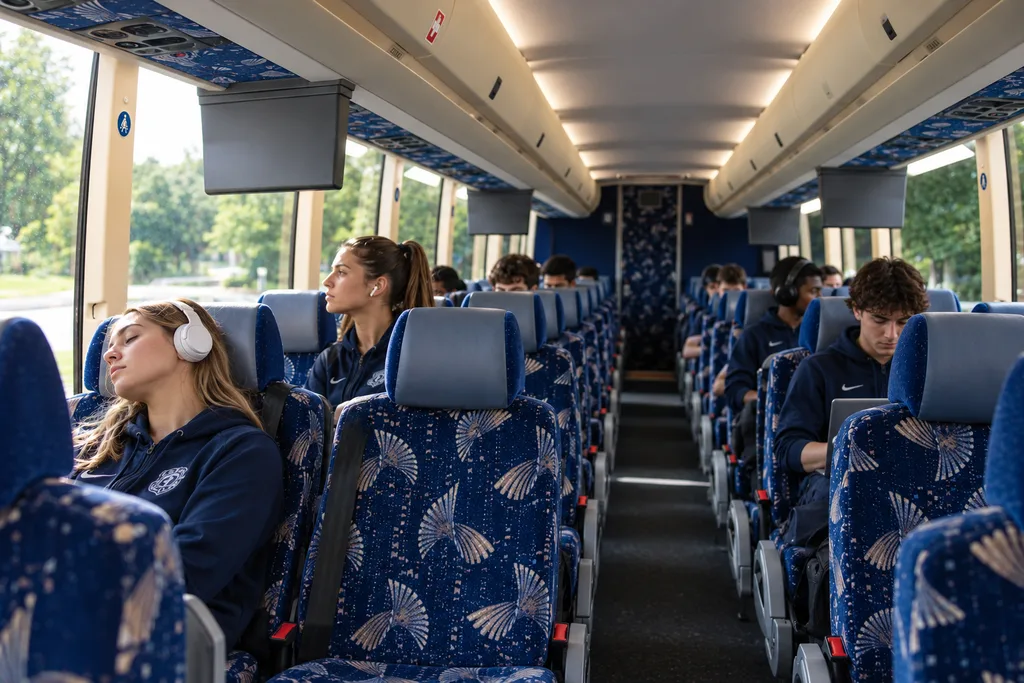
Comfortable reclining seats and adequate legroom can make a noticeable difference — particularly on longer trips. Players can relax, sleep, or simply get off their feet between the venue and the next destination.
This becomes especially important for teams traveling several hours at a time or competing on consecutive days. Fatigue compounds across a long weekend. A vehicle that supports rest between competitions is part of the recovery plan, not an afterthought.
The science supports this directly. A widely cited Stanford study on basketball players found that with 10 or more hours of sleep, shooting accuracy improved by approximately 10%. Conversely, sleep-deprived athletes saw accuracy drop by as much as 50% in the same measures. Separate research on college student athletes confirmed that short-term sleep deprivation significantly affects reaction time — even when anaerobic power remains largely unchanged. On long travel days, a vehicle where athletes can genuinely rest isn’t a comfort upgrade — it’s a performance variable. And for larger athletes, like basketball, football and volleyball- reclining is even more important.
When selecting a vehicle, consider more than the number of passengers. A roster that technically fits into an activity bus or minicoach may travel more comfortably in a full-size motorcoach on a four-hour drive.
The size of the athletes, the length of the trip, the pitch of the recliner and the legroom in front of each athlete can make the difference between arriving at a game ready to play at peak levels or seeing performance suffer.
Storage for Athletic Equipment and Luggage
College teams rarely travel light.
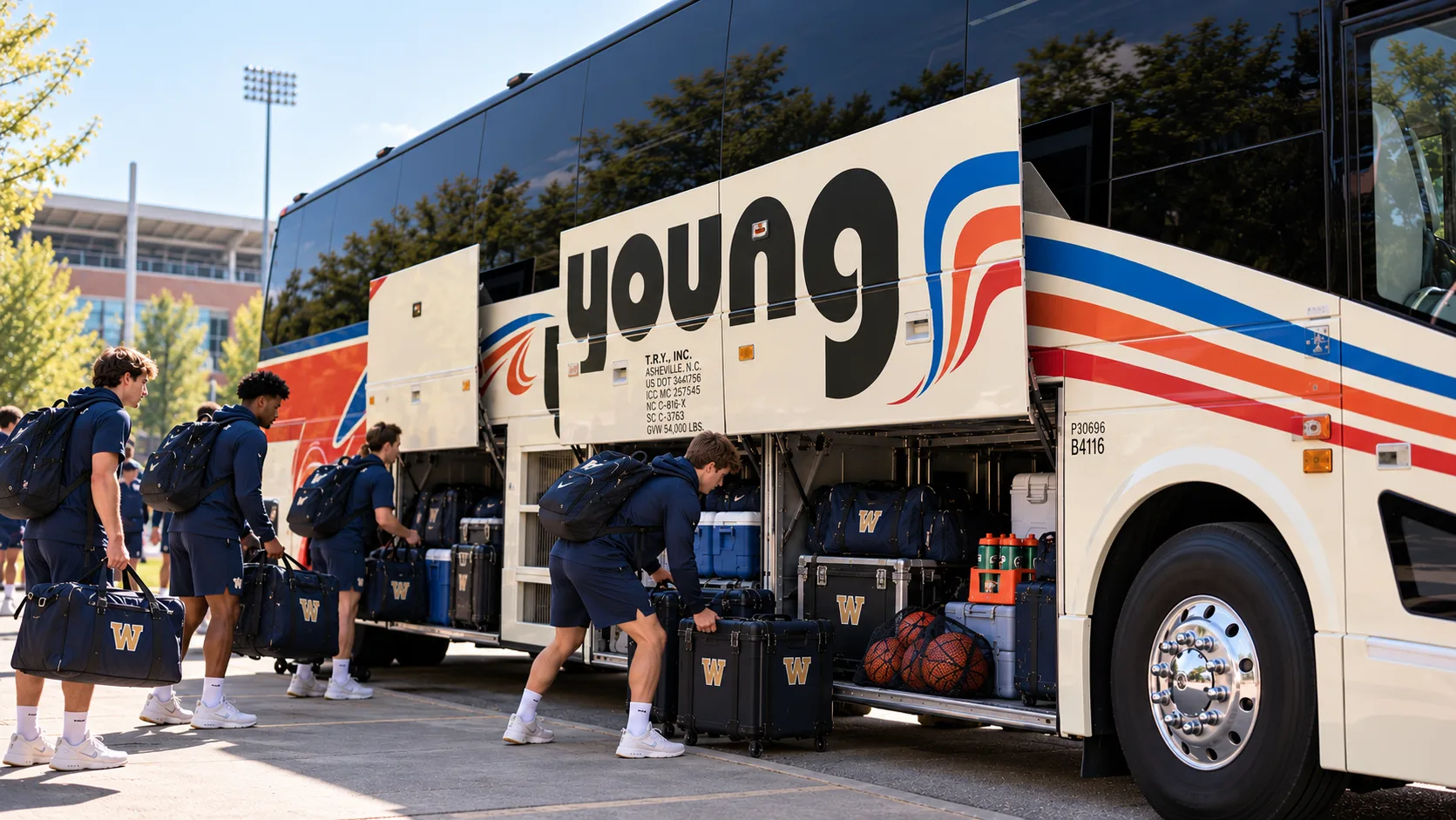
Depending on the sport, a team may be carrying uniforms, personal luggage, training supplies, coolers, medical equipment, and bulky athletic gear. A full-size motorcoach with undercarriage storage allows much of that equipment to stay outside the passenger cabin, leaving athletes and staff with more usable space onboard.
Before the trip, it helps to provide your transportation partner with an accurate equipment list. A football team may have very different storage requirements from a basketball, soccer, or track team — even when the passenger counts are similar. And because a football travel party of players, coaches, athletic trainers, and equipment staff often spans more than one motorcoach, it pays to plan cargo space vehicle by vehicle, not just for the team as a whole. Getting that detail right early prevents problems at the loading dock on departure morning.
Wi-Fi and Charging Access
Travel time doesn’t necessarily mean downtime.
Athletes may need to review class materials, communicate with professors, catch up on schoolwork or even stream video (perhaps for classwork, perhaps not!) while away from campus. Coaches and staff may need to manage schedules, communicate with the athletic department, or prepare for upcoming games on the road.
Available Wi-Fi and charging access make those hours more useful. For longer trips — especially those taking place during the academic week — these amenities can be particularly valuable for programs managing both competition schedules and academic requirements simultaneously.
A Pac-12 study on student-athlete well-being found that athletes reported being “too exhausted to study effectively” as a direct consequence of travel demands. Travel time with reliable connectivity gives athletes a practical window to stay on top of coursework — which matters for eligibility and for the student-athletes themselves.
Climate Control
It may sound basic, but a comfortable cabin temperature matters when you’re transporting a full team.
Athletes may board immediately after competing, travel during hot summer weather, or spend hours on the road during colder parts of the season. Reliable climate control helps keep the cabin comfortable throughout the trip.
It’s the kind of amenity passengers don’t think much about when everything is working properly — but notice quickly when it isn’t. For athletic departments coordinating travel across seasons, confirming vehicle climate systems are functioning before departure is a reasonable part of the pre-trip checklist.
Onboard Restroom
For longer-distance travel, an onboard restroom reduces unnecessary stops and keeps the trip moving on schedule.
That doesn’t eliminate the need for planned breaks — particularly on longer itineraries — but it gives teams additional flexibility when traveling between campuses, hotels, venues, and other destinations. When a schedule includes a specific arrival time for warmups, meals, or competition, fewer unplanned stops makes the itinerary easier to manage.
Full-size motorcoaches typically include onboard restrooms. For trips over two to three hours, this is one of the more practical differences between vehicle types.
Entertainment Options
Not every hour onboard needs to be productive.
After competition, athletes and staff may want to watch a film, listen to music, or decompress with teammates. Depending on the motorcoach, onboard entertainment options, particularly streaming options, can make longer drives feel considerably shorter.
For teams that spend a meaningful part of their season traveling together, the bus often functions as an extension of the team environment. Having space to relax together can be just as useful as having space to work — and the informal time between destinations is part of what builds a cohesive traveling party.
The Right Vehicle for the Team
Amenities matter, but they should be evaluated alongside the team’s overall transportation needs.
Passenger count is only the starting point. A transportation plan should also account for the sport, equipment requirements, trip duration, number of coaches and support staff, accessibility needs, hotel arrangements, venue access, and the team’s full schedule.
How the trip is run matters as much as how long it is. A University of Hawaiʻi study of NCAA Division I football players found that athletes reported better sleep quality and lower fatigue on away trips than at home — a result the researchers linked to structured travel routines. With conference realignment sending more football programs on longer road trips, a predictable, well-equipped ride is one of the easiest parts of that routine to control.
For some trips, a smaller mincoach is appropriate. For others, the additional passenger space and storage capacity of a full-size motorcoach makes the travel experience significantly more manageable — for the athletes, the coaching staff, and whoever is coordinating the logistics.
Not sure which vehicle fits your program? Charter Bus Sizes Explained walks through the options by passenger count and use case, and our fleet page covers what Young Transportation operates.
It’s also worth noting that from a safety standpoint, motorcoach travel is among the most favorable modes of highway transportation available. According to data from the National Transportation Safety Board, bus occupants are significantly safer than passenger car occupants. For athletic departments responsible for student safety on the road, professional commercial carrier standards represent a meaningful difference from self-driven rental van arrangements.
Plan College Athletic Travel with Young Transportation
Young Transportation works with college athletic programs to coordinate transportation around the realities of team travel.
Whether you’re planning transportation for a single away game or coordinating travel across an entire season, our team can help determine the appropriate vehicle, amenities, and logistics based on your group. From campus pickup and hotel transportation to competition-day schedules and longer regional trips, we help keep the transportation side organized so coaches and athletes can stay focused on what’s ahead.
For more on planning college team travel within the Southeast, see our college athletics travel guide and college athletics charter services.
Contact Young Transportation to discuss your upcoming college athletic travel needs — no obligation, and we typically respond within one business day.
Or call us directly: (800) 622-5444